Shot this out of the office window today using Canon 550D and Canon 24 to 105 f/4L lens. Using the Magic Lantern "hack", the in-built intervalometer was set to take a shot every 2 seconds, making sure that the lens was set to MANUAL focus and that the camera was in AV (aperture priority) mode to ensure that the exposure was maintained through a change in shutter speed. Using AV ensures that the aperture remains constant, and thus, the depth of field remains constant too.
The 500 or so images were then taken into Quicktime Player 7 before exporting the sequence using Apple ProRes 422 (LT) with a 1920 x 1080 crop (as the original JPEG images have a 3:2 aspect ratio) before using the Variable Blur filter in Apple's MOTION.
The final sequence was graded using Magic Bullet Quick Looks and exported to MPEG4.
Showing posts with label creative-media-technology. Show all posts
Showing posts with label creative-media-technology. Show all posts
Friday, July 27, 2012

Monday, July 23, 2012
Safety Recording
I always try to drum into my students the importance of making the best use of two channel recording, whether it be directly on a camera, or via something like the Zoom H4N. If a single MONO source is being used (which it often is in location recording), why not make the best use of both recording channels? Why send an EXACT duplicate to both channels of the recorder when a better strategy would be to send a lower level backup to channel 2 which can be "got at" in post, if needed? Some cameras and recorders enable the user to direct the INPUT 1 to both channel 1 and channel 2 but sometimes it is still not possible to change the gain settings independently and instead, equal gain is applied to both recording channels. Therefore, a cheap and effective way of achieving this is to make use of a microphone splitter cable (female XLR to TWO male XLR). A video demonstrating this is available via my Vimeo Channel - www.vimeo.com/digitalvideoslr or directly via an RSS feed here.
There are some devices available which will enable the gain settings for both channels to be independently changed, even for a single mono input, however if the device doesn't allow this (as in the case of the Zoom H4N for example), this option is most effective....
In post, rather than having an exact duplicate of the recording obtained across both channels, one will have a backup copy, say 10dB lower in level, on channel 2, which can be used if there is any sudden overload on channel 1. It might not be needed, but at least there is a backup just in case!
Tilt Shift Timelapse
I have decided to explore the world of Time-Lapse Tilt-Shift creation this summer when I embark on a short cruise (courtesy of the Queen Victoria / Cunard). Providing one can position the camera high enough above the subject, it is possible to create some very convincing tilt-shift effects by simply using some kind of mask to alter the focus of some parts of the image (i.e. to create a short DoF). Therefore, the plan is to try and position the camera high enough on the ship to hopefully capture a series of still images which can later be processed to give the tilt-shift effect. I have already made a prototype sequence, shot from my office window and the result was most pleasing.... As can be seen, simply narrowing the DoF in the image (by de-focusing part of the image via a mask), turns the sequence into a "minature". As mentioned, this only works if one can position the camera way above the subject to give the impression of a "giant" peering down over it :)
Thursday, July 19, 2012
Downstairs Shower Room refurb in 5 days....


Very pleased.....
Monday, June 11, 2012
Decking in just one day
Very pleased - managed to build a 4.8m x 4m garden deck complete with 18 LED lights in just one day from scratch. I sourced some plastic adjustable feet from eBay which negated the need to construct the deck from the usual wooden posts, concreted into the ground. This new way allowed us to build the outer frame first, level it off using the adjustable feet (sat on concrete pad stones where necessary), before in-filling with joists. The feet are required every 1m or so, which also enabled the deck frame to be constructed from 3"x2" timber rather than the usual 6"x2", as it was so well supported. The whole frame is also fixed to the house wall using joist hangers too.


Thursday, March 08, 2012
Shed alterations
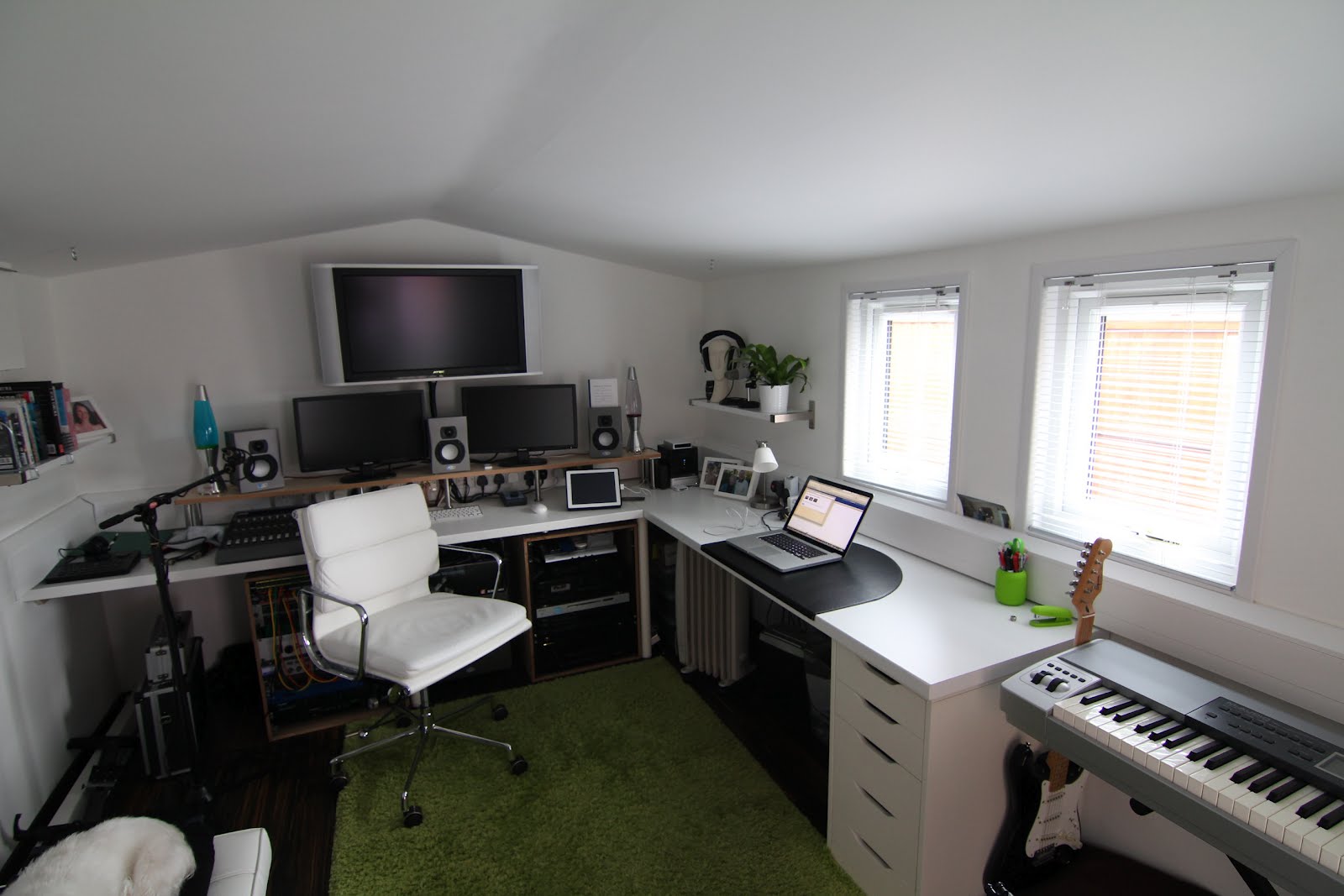


Forgot to post this at the time, so thought I'd add it now (better late than never!).
I was never happy with the fact that I didn't install any windows in my garden lodge, so last summer I fitted two windows to the side elevation along with some new worktop :)
I also treated the outside to a sand and an oil, which really brings out the cedar....
Thursday, February 09, 2012
Pluraleyes with multiple cameras and separate sound
Recently I have been playing around with using Pluraleyes to synchronise multiple cameras, all containing "scratch" audio, together with sound recorded on a separate solid state audio device. Once again, Pluraleyes worked flawlessly (once I developed a additional stage first) and the fact that it also automatically makes a multi-clip for Final Cut, makes it even better. I will shortly be testing out the new multi-cam and synchronise feature in Final Cut X which might make this method redundant, but here is my workflow for synchronising multiple cameras and separate sound for multiclip editing:
Firstly, transcode footage to both ProRes and ProRes PROXY (this is done as sometimes, depending upon the number of clips, and the power of your machine, Final Cut will struggle with the playback).
Secondly, use Pluraleyes to sync the separate sound to one of the camera angles.
Thirdly, export this as a new Quicktime file (you can use the reference movie option to save disc space).
Now, reimport this file back into Final Cut and use Pluraleyes to sync this file to the remaining camera angles.
Pluraleyes will make a multiclip with all cameras now synchronised.
Once edited, one can use the RECONNECT MEDIA option to relink the edit back to the original ProRes files.
Firstly, transcode footage to both ProRes and ProRes PROXY (this is done as sometimes, depending upon the number of clips, and the power of your machine, Final Cut will struggle with the playback).
Secondly, use Pluraleyes to sync the separate sound to one of the camera angles.
Thirdly, export this as a new Quicktime file (you can use the reference movie option to save disc space).
Now, reimport this file back into Final Cut and use Pluraleyes to sync this file to the remaining camera angles.
Pluraleyes will make a multiclip with all cameras now synchronised.
Once edited, one can use the RECONNECT MEDIA option to relink the edit back to the original ProRes files.
Tuesday, January 03, 2012
Update
It's been a while since my last post, but just wanted to add a quick update to the Blog. Firstly, I have recently purchased a DSLR base plate with standard rods from a supplier in Hong Kong via eBay. Usually these things retail for around £150 minimum, but I paid about £58 so very pleased about that. The beauty of these things is that they allow for better positioning of my DFocus follow focus and also, at a later date, it is easy to adapt it into a full shoulder rig too.
Here is a quick picture of it:

As can be seen from the picture, as I have a battery grip on the 550D, the rods become too low to allow the gears on the FF to match up with the lens gear. Therefore, I sourced an additional pair of 6" rods and a riser from eBay to effectively "lift" the FF up closer to the lens. One can obtain something called the "DRISER" from Jag35.com to do the same thing, but this actually works out more expensive than buying two rods and an adaptor!
I also fitted the DSLR base plate with a Manfrotto quick release plate so that it can be quickly detached from the tripod.
Also looking at purchasing either a Canon 28mm f1.8 USM lens or Sigma 30mm f1.4 lens but can't decide which one. The Canon is probably slightly better than the Sigma, but the Sigma is a little bit "faster" with its 1.4 aperture.
Very recently also bought a new microphone too. I didn't want a shotgun as I can borrow these quite easily, but did want a cheap hypercardioid mic for indoor work. The choices are either the AKG CK93 capsule on the SE300 body (about £300), or the AT 4053b (about £450 ish), the Oktava MK-012 or going much more expensive, something from Schoeps. I didn't want to spend a great deal, and was lucky enough to find some end of the line Studio Electronics SE2A true condenser mics with three capsules (OMNI, CARDIOID and HYPER-CARDIOID) for only £75. The mic is lightweight and seems to perform well.


Here is a quick picture of it:

As can be seen from the picture, as I have a battery grip on the 550D, the rods become too low to allow the gears on the FF to match up with the lens gear. Therefore, I sourced an additional pair of 6" rods and a riser from eBay to effectively "lift" the FF up closer to the lens. One can obtain something called the "DRISER" from Jag35.com to do the same thing, but this actually works out more expensive than buying two rods and an adaptor!
I also fitted the DSLR base plate with a Manfrotto quick release plate so that it can be quickly detached from the tripod.
Also looking at purchasing either a Canon 28mm f1.8 USM lens or Sigma 30mm f1.4 lens but can't decide which one. The Canon is probably slightly better than the Sigma, but the Sigma is a little bit "faster" with its 1.4 aperture.
Very recently also bought a new microphone too. I didn't want a shotgun as I can borrow these quite easily, but did want a cheap hypercardioid mic for indoor work. The choices are either the AKG CK93 capsule on the SE300 body (about £300), or the AT 4053b (about £450 ish), the Oktava MK-012 or going much more expensive, something from Schoeps. I didn't want to spend a great deal, and was lucky enough to find some end of the line Studio Electronics SE2A true condenser mics with three capsules (OMNI, CARDIOID and HYPER-CARDIOID) for only £75. The mic is lightweight and seems to perform well.
Wednesday, September 28, 2011
Timelapse video
Been playing again with creating timelapse video sequences and now I understand the process much better.
Firstly, unless you really need the extra resolution (i.e. perhaps you plan to zoom in on a section of video for example), then the camera can be set to its lowest JPEG image setting. In the case of my 550D this happened to be 2592 x 1728 which is obviously much higher than is needed for standard 1080P HD video.
Secondly, as most DSLR cameras take their pictures with an aspect ratio of 3:2, we need to ensure that when exporting the image sequence to 1920 x 1080, that the aspect ratio is preserved, otherwise horizontal stretching will occur.
Any way, the way I carried out my timelapse was to record a series of images every 5 seconds (using Magic Lantern's built in intervalometer) and to simply then take these into Quicktime Player 7 using its "OPEN IMAGE SEQUENCE" option.
Upon doing this, a window will appear asking what frame rate to use - I simply chose the standard PAL of 25fps.
The sequence can then be exported and I chose to use Apple ProRes LT (in case I wanted to take the finished video in a FCP project) with a resolution of 1920 x 1080. IMPORTANT: you need to make sure that PRESERVE ASPECT RATIO using CROP is selected to ensure that the resultant video file is not stretched.
Job done!
Firstly, unless you really need the extra resolution (i.e. perhaps you plan to zoom in on a section of video for example), then the camera can be set to its lowest JPEG image setting. In the case of my 550D this happened to be 2592 x 1728 which is obviously much higher than is needed for standard 1080P HD video.
Secondly, as most DSLR cameras take their pictures with an aspect ratio of 3:2, we need to ensure that when exporting the image sequence to 1920 x 1080, that the aspect ratio is preserved, otherwise horizontal stretching will occur.
Any way, the way I carried out my timelapse was to record a series of images every 5 seconds (using Magic Lantern's built in intervalometer) and to simply then take these into Quicktime Player 7 using its "OPEN IMAGE SEQUENCE" option.
Upon doing this, a window will appear asking what frame rate to use - I simply chose the standard PAL of 25fps.
The sequence can then be exported and I chose to use Apple ProRes LT (in case I wanted to take the finished video in a FCP project) with a resolution of 1920 x 1080. IMPORTANT: you need to make sure that PRESERVE ASPECT RATIO using CROP is selected to ensure that the resultant video file is not stretched.
Job done!
Monday, September 26, 2011
Canon 5D MKIII or 6D?
Been thinking lately about whether to jump to full frame and get the 5D MKII. Currently (Sept '11), you can snap (excuse the pun) a 5D MKII and 24 to 105 f/4 IS L lens for around £2100. This fairly large discount must be due to the imminent arrive of the 5D MKIII or its equivalent.
I watched a few comparison videos last night looking at the features of the 5D MKII and the 7D and from these, what I have learnt is that I'd like a full frame version of the 7D and not really the 5D MKII which has a few outdated features.
I therefore came across a few rumours of a "6D", which will be a lower priced full frame DSLR with perhaps the features of the existing 7D :)
Hopefully this will happen soon......
I watched a few comparison videos last night looking at the features of the 5D MKII and the 7D and from these, what I have learnt is that I'd like a full frame version of the 7D and not really the 5D MKII which has a few outdated features.
I therefore came across a few rumours of a "6D", which will be a lower priced full frame DSLR with perhaps the features of the existing 7D :)
Hopefully this will happen soon......
Tuesday, May 17, 2011
DSLR Cinema

I've recently been told about a new book called DSLR Cinema by Kurt Lancaster. Looks good and have ordered a copy....
Monday, January 10, 2011
Field of view tool
This is an excellent tool for showing the difference between different sensor sizes and how it affects the field of view. Wish there was one to show DoF too.
http://www.abelcine.com/fov/
http://www.abelcine.com/fov/
Wednesday, December 22, 2010
Glidetrack Shooter SD


Just purchased a Glidetrack Shooter SD from Alistair @ www.glidetrack.com. I cannot recommend this product highly enough - it is simply an awesome piece of kit, especially when linked with the Manfrotto 577QR quick release place and Manfrotto 701HDV head.
Here are few videos I have shot with it recently:
http://www.vimeo.com/17981477
http://www.vimeo.com/17979791
http://www.vimeo.com/17953967
Sunday, November 14, 2010
1/30s Shutter?
Due to the 180 degree shutter used in film cameras, the optimum shutter speed on a digital SLR should usually be around 1/2n where n = frame rate. For PAL 25fps therefore, the shutter should be 1/50s. If you shoot with a higher shutter than this, you can get very "staccato" looking images, especially during fast motion shots. However, what about shooting at the camera's minimum of 1/30s? The image might become too soft and there might be too much motion blur, however it's something I am going to try soon. The benefit of this is that for low light shooting, you can get away with a lower ISO or smaller aperture.....
Posted a demonstration video showing different shutter speeds at my Vimeo pages: www.vimeo.com/digitalvideoslr
Posted a demonstration video showing different shutter speeds at my Vimeo pages: www.vimeo.com/digitalvideoslr
Saturday, November 06, 2010
DSLR CAMFRAME

Just bought a DSLR Camframe from B-Hague in Nottingham as shown here (without the camera which was taking the picture!). It provides side and top handles together with two additional hot shoe mounts (which I have used to mount my 126 LED light to one side, and HDMI field monitor / Zoom H4N to the other side).
Wednesday, November 03, 2010
Canon XLH1s vs. Canon 550D
Decided that in a few weeks time I am going to make a demonstration video comparing the differences / similarities of the Canon 550D SLR and the Canon XLH1s camcorder. I want to compare the DoF available with the same aperture on both. The Canon XLH1s, like many camcorders is around a x7 crop factor so I would have thought that with say an f1.8 aperture, the DoF is still going to be extremely deep. The plan is to film a tape measure from an angle so that the DoF can be measured and compared. The camcorder lens is a 5.5mm to 108mm "L" lens (equivalent to approx. 38mm to 778mm in 35mm format) and has a maximum f number of 1.6. Should be an interesting comparison.
Wednesday, October 20, 2010
Light tests
Have just taken delivery of 126 LED light. Will post a comparison video of it very soon when I get chance to make one!
Saturday, October 16, 2010
Jamie's 30 Minute Meals
Just been watching a behind the scenes video of Jamie Oliver's new Channel 4 series and noticed that they were using a DSLR for some of the shots. Looked like the 70 to 200l f2.8 lens was being used in one of the shots. They also appear to be using RED ONE cameras too.
http://www.channel4.com/food/on-tv/jamie-oliver/jamie-s-30-minute-meals/index.html
http://www.channel4.com/food/on-tv/jamie-oliver/jamie-s-30-minute-meals/index.html
Thursday, October 14, 2010
LIGHT

Been looking at the Litepanels range of portable LED lights to sit on top of the camera. Their Micro Pro looks excellent but it retails for around £300!
I therefore visited eBay and after a bit of hunting around and review checking on YouTube, I have opted for the "CN-126" 126 LED light panel, which apart from being made from plastic, looks more or less the same as the Litepanels one. The best thing is that it retails for £37.50 and will take rechargeable camcorder batteries.
It also comes with a diffuser filter too and is totally dimmable.
Friday, October 08, 2010
Great Sound Design Website
I always like to show my students sound design / sound for picture "making of" documentaries as I think that they inspire students to start wanting to play with sound and go out and about acquiring sounds which they can later work with.
A student told me about this website yesterday and it simply is fantastic with lots and lots and lots of documentaries regarding sound design for films:
www.soundworkscollection.com
A student told me about this website yesterday and it simply is fantastic with lots and lots and lots of documentaries regarding sound design for films:
www.soundworkscollection.com
Subscribe to:
Posts (Atom)